Is Your Dental Marketing Agency Doing Anything for AI Search? 8 Ways to Tell
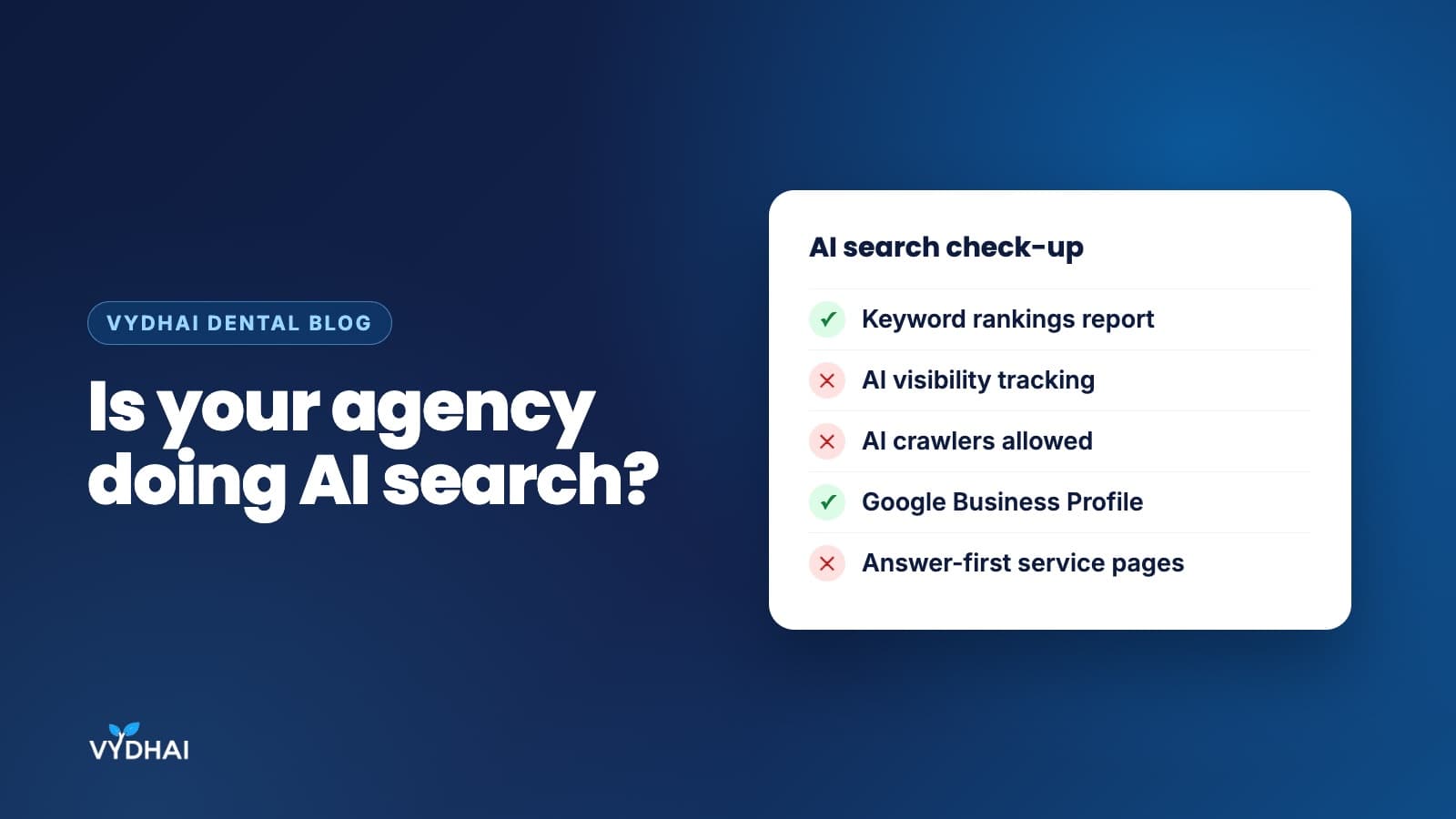
Why is this question worth asking now?
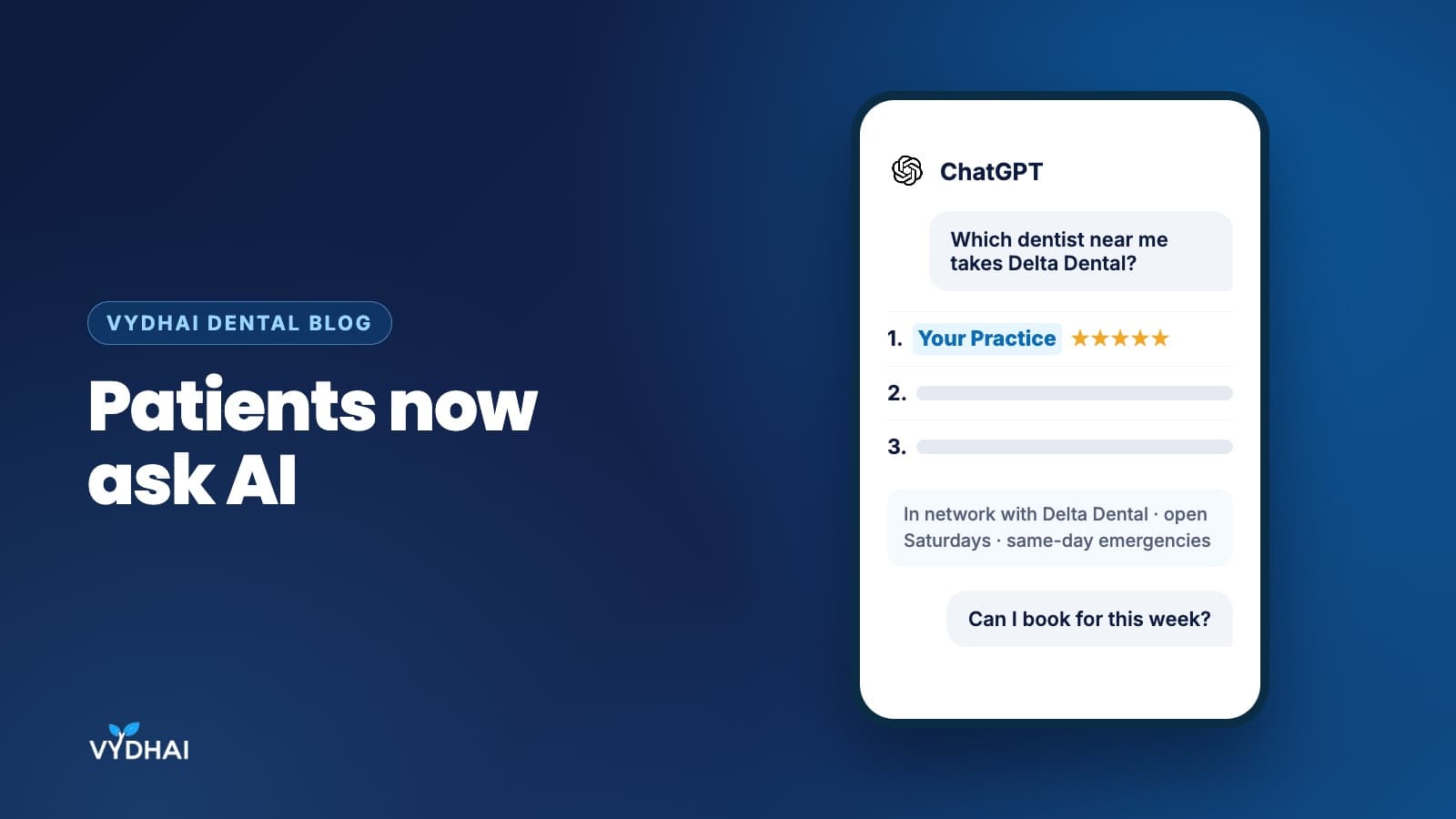
More patients now ask an assistant such as ChatGPT, Gemini, Perplexity or Google's AI Overviews to recommend a dentist instead of scrolling a list of links. The assistant reads what it can find about local practices and names a small handful. If your practice is not among them, the patient may never see your website at all.
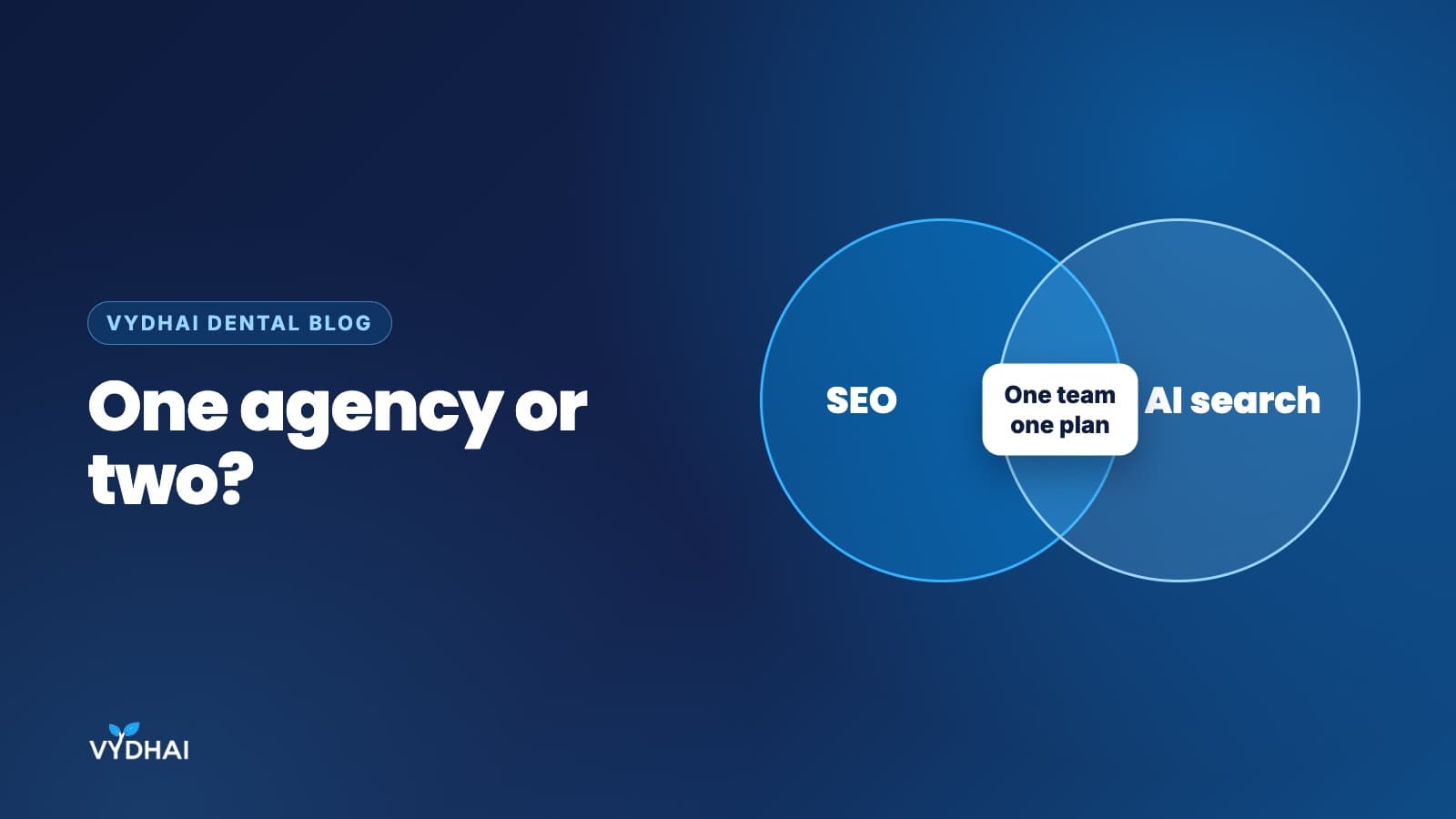
Most dental marketing agencies were built around rankings, ads and websites, and many are still doing exactly that work well. The problem is that good rankings do not automatically translate into being named in an AI answer. The two overlap, but they are not the same job. If you have never asked your agency what they are doing specifically for AI search, the honest answer may be "nothing yet" — and you deserve to know.
The eight checks below are things you can verify yourself, mostly without technical knowledge. None of them require taking anyone's word for it.
1. Do they measure what AI assistants say about your practice?
The first sign of real AI search work is measurement. An agency working on it should be able to show you a fixed list of patient-style questions — for example "which dentist near me is good with anxious patients?" — and what ChatGPT, Gemini, Perplexity and Google AI Overviews answered for each one, run on a schedule.
If your monthly report only shows keyword rankings, traffic and ad clicks, AI visibility is not being measured. That does not mean nothing is happening, but it does mean nobody can tell you whether it is working.
2. Can AI crawlers actually read your website?
Every AI platform sends its own crawler — GPTBot and OAI-SearchBot for OpenAI, PerplexityBot for Perplexity, ClaudeBot for Anthropic, and others. Your website's robots.txt file decides which of them may read your pages. Some hosting setups and security plugins block these crawlers by default, and the practice never finds out.
You can check this yourself by typing your domain followed by /robots.txt into a browser. If you see lines that disallow those crawler names, or a blanket rule blocking unknown bots, your site may be invisible to the assistants patients are using. An agency doing AI search work will have checked this already and can tell you what it says.
3. Are your service pages written as answers?
Open your implant, Invisalign or emergency page and read the first two sentences under each heading. Do they answer a question a patient would actually ask — what it is, who it suits, how long it takes, whether you take their insurance? Or do they open with a paragraph about your commitment to excellence?
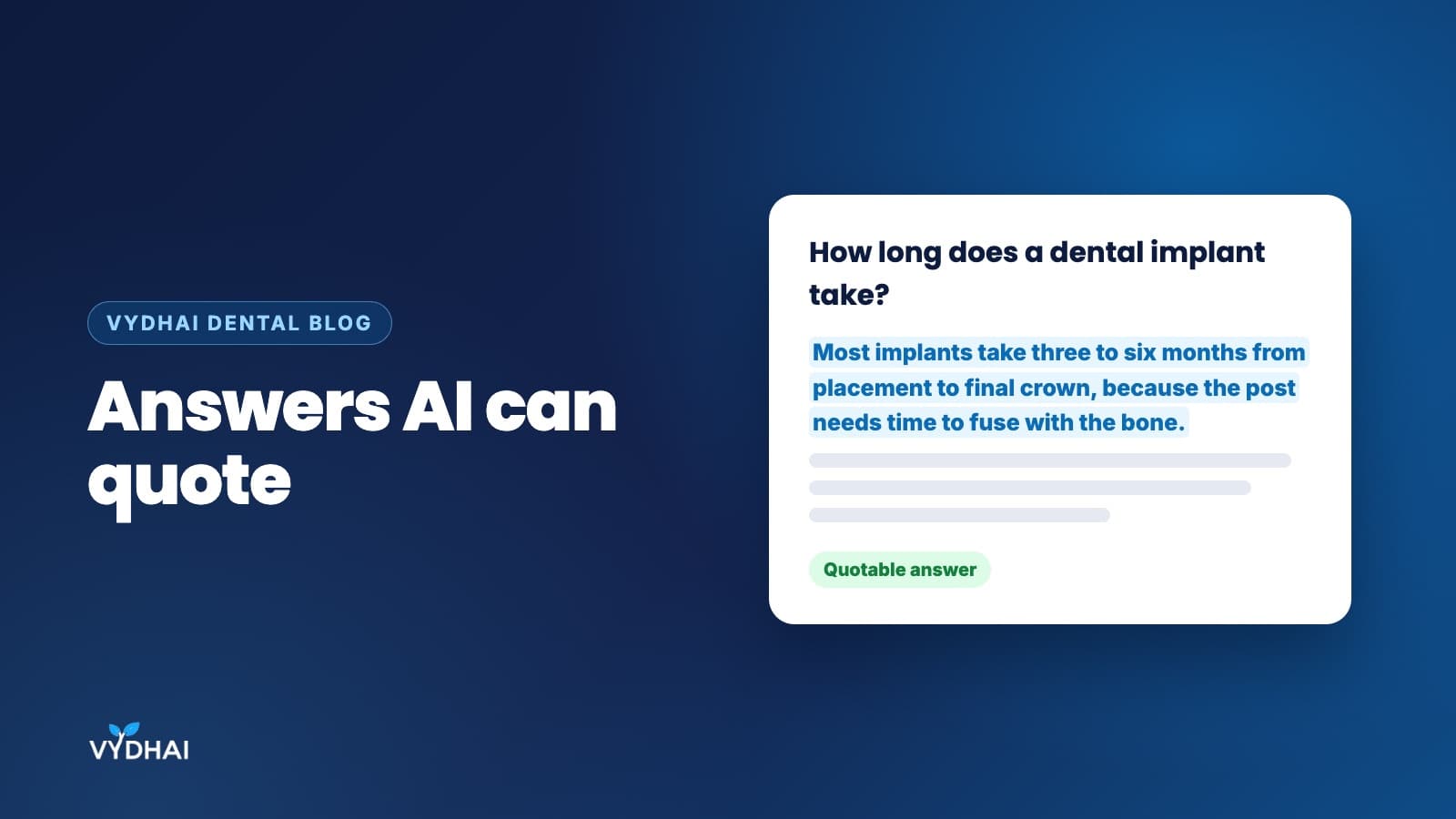
Assistants lift short, self-contained passages that resolve a specific question. Pages written in that answer-first style are a strong sign that someone has been optimizing for answer engines. Pages full of general marketing prose, however polished, give an assistant nothing specific to quote.
4. Is there structured data describing your practice and services?
Structured data, usually called schema markup, is a machine-readable description of your practice that sits in your page code: who you are, what services you offer, your location and hours, and answers to common questions. It reduces the chance that an AI system misreads or confuses you with another practice.
You can check it by pasting a page address into Google's free Rich Results Test or the Schema.org validator. Look for Dentist or LocalBusiness, Service, and FAQPage types that match what the page actually says. If the tools find nothing beyond a basic website entry, this work has not been done.
5. Do your facts match everywhere?
AI systems cross-check. If your website lists one set of hours, your Google Business Profile another, and an old directory listing a third, the model has to pick one or leave you out. The same goes for your address format, phone number, the services you list and the doctors at the practice.
Search your practice name and look at the first page of directory results — Google, Yelp, Healthgrades, Bing Places, Apple Maps. An agency doing AI search work will have a process for keeping these consistent, because consistency is one of the main signals that makes a model confident enough to name you.
6. Are you publishing dated, useful content?
Answer engines favor sources that are visibly current. A blog that stopped two years ago, or pages with no dates at all, gives a model little reason to believe the information is still accurate. Regular, dated articles that answer real patient questions — what to expect at a first visit, how a procedure works, what to do in a dental emergency — keep giving the assistant fresh material to draw from.
This is not about volume. One genuinely useful, accurate article a month beats ten thin ones. But if nothing new has appeared on your site this year, that is worth raising.
7. Is anyone working on mentions beyond your own website?
A model trusts what independent sources say about you more than what you say about yourself. Reviews, local news coverage, community sponsorships, professional association listings and reputable directories all count as corroboration.
Ask what your agency has done in the last quarter to earn or improve those mentions. If the answer is limited to on-site work, the external half of AI visibility is being left on the table.
8. Can they explain the work in plain language?
The last test is the simplest. Ask your agency to explain, in two minutes and without jargon, what they are doing so that ChatGPT or Google's AI Overview will recommend your practice. A team doing the work can describe it clearly: what they measured, what they changed, and what moved.
Be wary of two answers in particular. The first is "it's all just SEO", which is partly true but usually signals that nothing AI-specific is happening. The second is a guarantee of placement. Nobody controls what an AI model outputs, and an honest agency will say so.
A quick way to run the checklist yourself
You can work through all eight checks in under an hour. Ask the agency for its most recent report and look for any AI visibility section. Open your robots.txt. Read the first lines of your three most valuable service pages. Run one page through a schema validator. Search your practice name and scan the directory listings. Look at the date of your newest article, and ask the agency what it did beyond your website last quarter.
Note each check as done, partly done or not done. A simple tally is enough to start a productive conversation, and it keeps the discussion on what is visible rather than on what anyone believes is happening.
What should you do with the results?
If your agency passes most of these checks, good — ask to see the AI visibility measurements alongside your usual report so you can track progress together. If it fails most of them, that is not necessarily a reason to leave. Many agencies can add this work once a client asks for it.
What matters is that someone is responsible for how your practice appears in AI answers, and that the results are measured rather than assumed. If you would like an independent baseline first, our free AI Visibility Audit runs the patient-style prompts for your practice and shows exactly where you are named today.
Frequently asked questions
How can I tell if my dental marketing agency is working on AI search?+
Ask to see a fixed list of patient-style questions and what ChatGPT, Gemini, Perplexity and Google AI Overviews answered for each, tracked over time. Then check that AI crawlers are allowed in your robots.txt, that service pages lead with direct answers, and that schema markup describes your practice. If none of these exist, AI search is not being worked on yet.
Is ranking well on Google enough to show up in ChatGPT?+
Not on its own. Strong rankings help, because AI systems often draw on pages that search engines already trust, but an assistant also needs short, quotable answers, consistent facts across directories, and independent mentions before it confidently names a practice. A practice can rank on page one and still be missing from AI answers.
Can an agency guarantee my practice will be recommended by ChatGPT?+
No. Nobody controls what an AI model outputs, and answers vary with wording, location and model version. An honest agency will describe the signals it is improving and measure results over a fixed set of prompts, but it will not promise a placement.
Ready to Become the Practice AI Recommends?
Book a free, no-obligation strategy call. We'll show you exactly how ChatGPT, Perplexity, and Google AI talk about your practice — and the plan to win the answer.
- What ChatGPT, Perplexity & Google AI say about you
- Where competitors are winning the AI answer
- Your local search & Google Business Profile
- Website speed and AI-readability
- Current ads and call/form tracking
What you'll walk away with
- Your AI visibility snapshot
- A clear AI-First roadmap
- A plan for more booked new patients
No obligation · US-based team · Dental-only