Do Dentists Need a Separate AI Search Agency, or Can Your SEO Agency Handle It?
The short answer
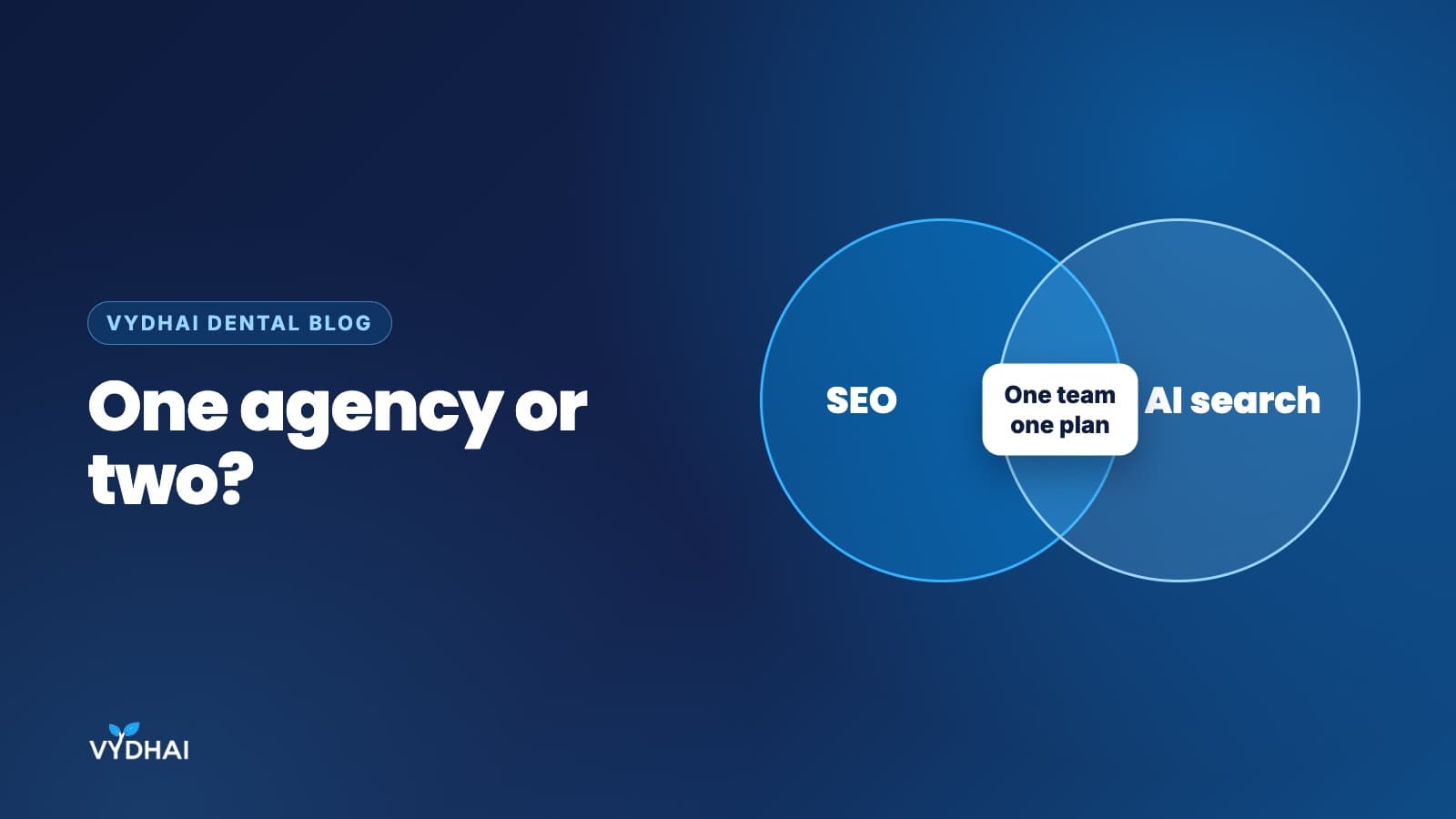
Most dental practices do not need two agencies. AI search work — usually called GEO (Generative Engine Optimization) or AEO (Answer Engine Optimization) — overlaps heavily with good SEO, and splitting it between two teams tends to create gaps, duplicated effort and conflicting changes to the same website.
What you do need is one team that treats AI search as its own job with its own measurement, rather than assuming it happens as a side effect of rankings. Whether that is your current agency or a new one depends on whether they can do that job, not on what they call themselves.
Where SEO and AI search overlap
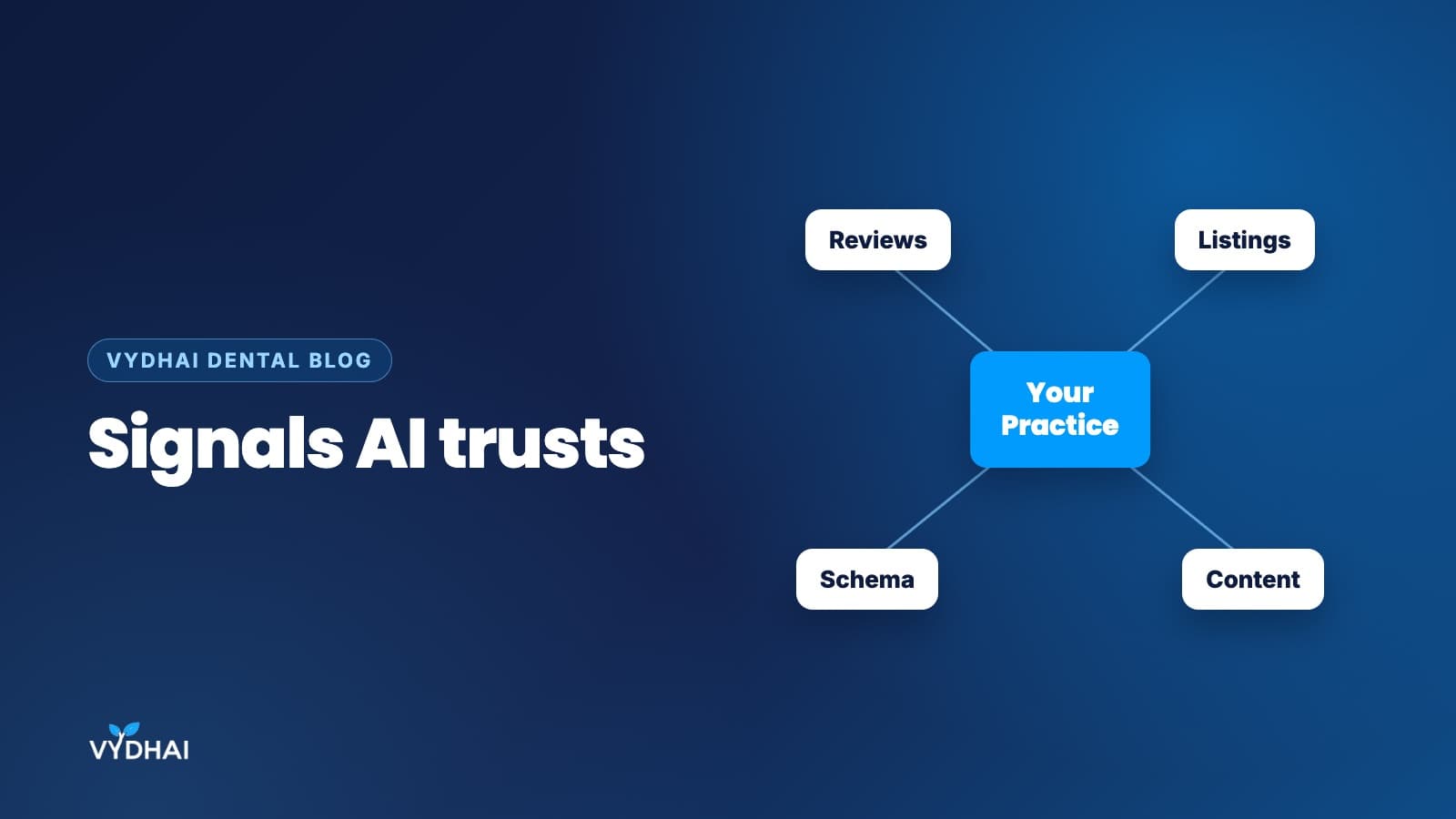
AI assistants mostly draw on pages that search engines have already discovered and trust. That means the foundations of SEO — a fast, crawlable website, clear service pages, accurate local listings, a healthy Google Business Profile and genuine reviews — are also the foundations of AI visibility.
If those basics are weak, no amount of AI-specific work will compensate. This is the strongest argument for keeping the work with one team: the same pages, listings and technical setup serve both goals, and changes for one affect the other.
Where AI search is genuinely different
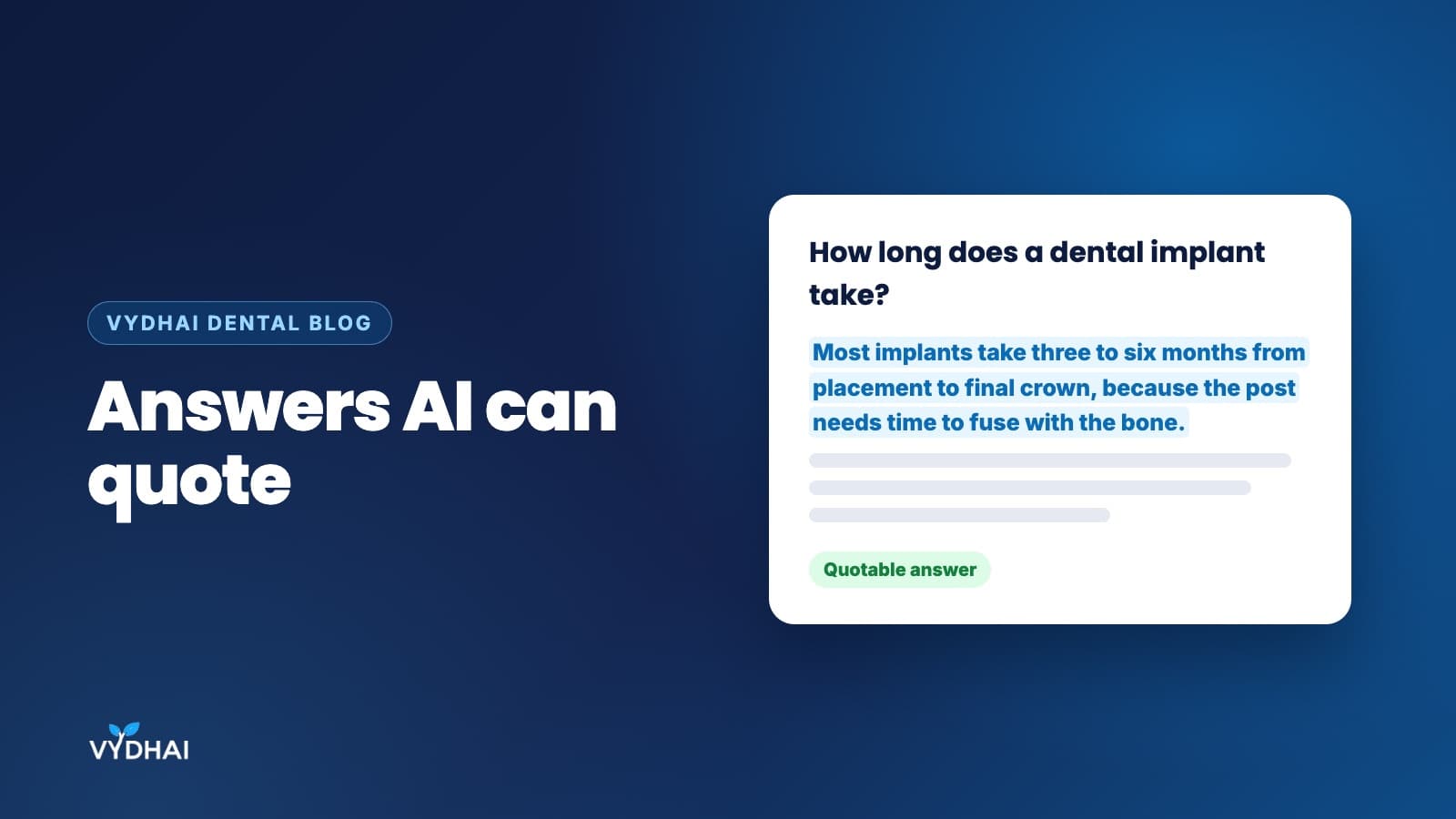
The differences are real, though, and they are why a traditional SEO program often misses AI answers. The first is the unit of success. SEO optimizes a page to rank. AI search optimizes passages to be quoted — short, self-contained answers an assistant can lift and attribute.
The second is crawler access. AI platforms use their own crawlers, and whether they can read your site is controlled separately from Google's crawler. The third is corroboration: models weigh what independent sources say about you, which pushes more importance onto reviews, directories and mentions beyond your own site.
The fourth, and the one most often skipped, is measurement. Rankings do not tell you whether ChatGPT names your practice. That has to be checked directly, with a fixed set of patient-style prompts, across several assistants, on a schedule.
When asking your current SEO agency makes sense
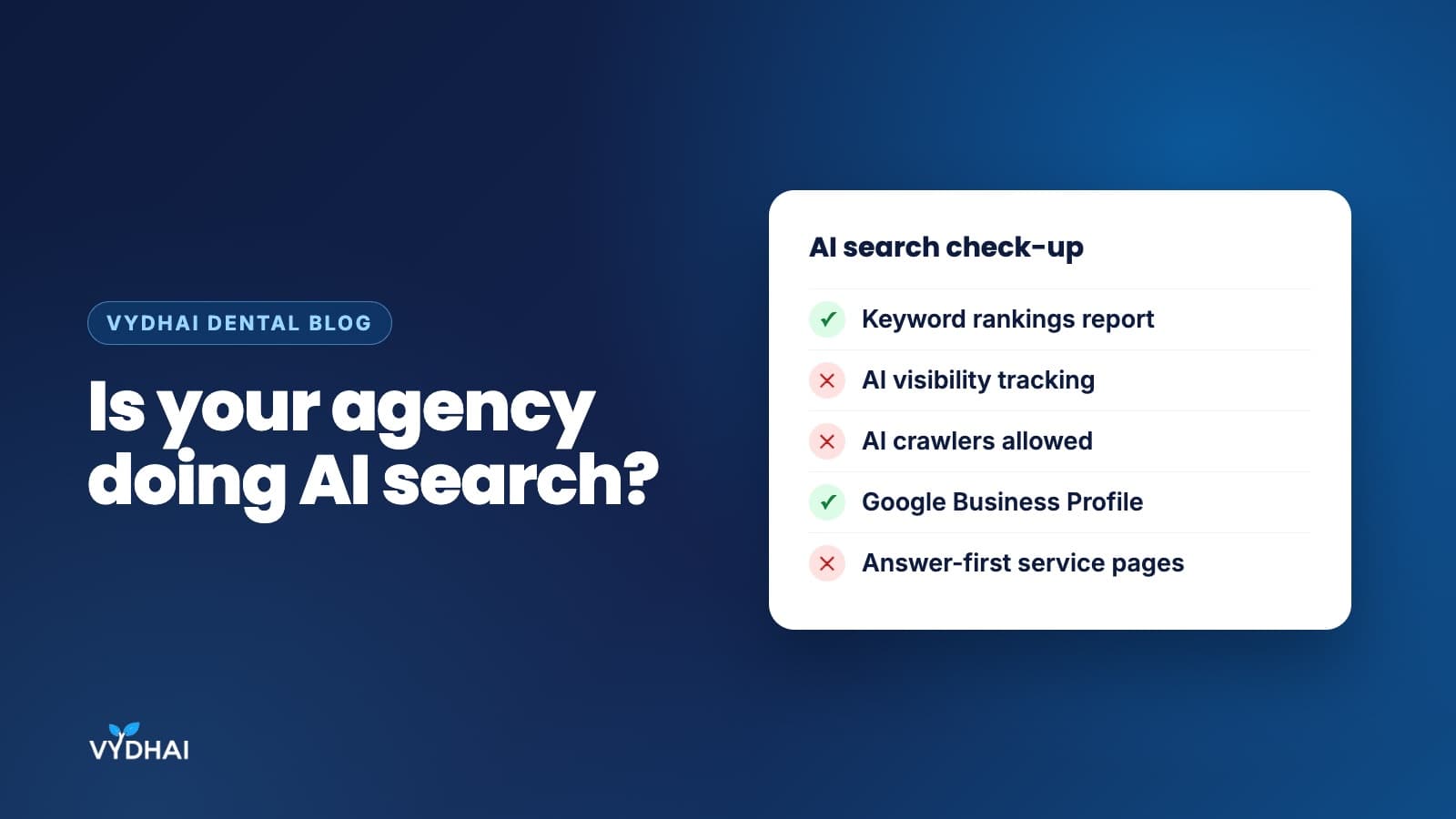
If you are happy with your agency's SEO work, start by asking them. Ask what they are doing specifically for AI search, how they measure it, and whether they can add AI visibility tracking to your monthly report.
A capable agency will give you a clear plan: an AI visibility baseline, crawler access checks, answer-first rewrites of key service pages, structured data, a review and listings program, and a regular re-measurement. If they can describe that plan and start measuring within a reasonable time, keeping the work in one place is usually the simpler and cheaper path.
When a different agency makes more sense
Consider a change if your agency dismisses AI search as hype, says it is "just SEO" without showing any AI-specific measurement, or cannot explain what they would do differently. Those answers usually mean the work will not happen, however good their intentions.
It also makes sense to look elsewhere if your agency does not control the pieces that matter. If one company built your website, another manages your listings and a third runs ads, nobody may be in a position to make the changes AI search requires. In that situation, consolidating with a team that can work across the website, listings and content is often more effective than adding another specialist.
Why two agencies on one website rarely works
Running a separate AI search agency alongside an SEO agency sounds tidy on paper. In practice, both teams need to edit the same service pages, the same structured data and the same listings. Changes made by one can undo the other's work, and when results move, neither can say with confidence which change caused it.
Reporting also fragments. You end up with two dashboards describing overlapping work, and the question you actually care about — are more patients finding us, through any channel? — falls between them. A single accountable team avoids that.
What AI search work involves month to month
It helps to know what you are asking for. A working AI search program usually has a fixed rhythm. Each month: re-run the same set of patient-style prompts across the major assistants and record the results; review crawler access and indexing; publish or refresh content that answers real patient questions; and keep listings and reviews moving.
Each quarter: look at which prompts improved and which did not, rewrite the service pages that still are not being quoted, and update structured data to reflect any changes at the practice. None of it is exotic. What makes it work is that it is done deliberately and measured, rather than hoped for as a side effect of other work.
Signs the split is already causing problems
If you already have two vendors touching your website, a few symptoms suggest they are getting in each other's way. Pages change without anyone being able to say who changed them or why. Your structured data contains duplicate or conflicting descriptions of the practice. Reports from each vendor take credit for the same improvement, or blame each other for the same drop.
None of these are disasters, but each one makes AI search harder, because consistency is exactly what assistants reward. Agreeing on one owner for the website, listings and content usually resolves them quickly.
Questions to settle the decision
Ask your current agency three things. What do ChatGPT, Gemini, Perplexity and Google AI Overviews say about our practice today? What specifically will you change so that improves? How will we see the result each month?
If you get clear, specific answers, keep the work together. If you get vague ones, it is reasonable to get an independent baseline before you decide. That baseline is useful either way: it tells you where you stand and gives whichever team you choose something concrete to improve against.
What to expect in the first few months
Whichever route you take, AI search results build gradually. In the first month you should see a baseline: which questions you are named for, which assistants mention you, and what they get wrong. Technical fixes such as crawler access and indexing usually follow within weeks, and content rewrites and structured data take several weeks more to be reflected in answers.
Reviews and outside mentions build over months. A reasonable expectation is steady movement across the full set of prompts — first being cited as a source, then mentioned, then named — rather than a sudden jump. If nothing has been measured after the first month, that is the clearest sign the work is not really happening.
Ask for the baseline in writing, so that six months from now both you and the agency can see exactly what has changed.
How we approach it
At Vydhai we treat AI search and SEO as one program with two kinds of measurement. The same team handles the website, structured data, listings and content, and the monthly report shows both search rankings and how the practice appears in AI answers.
If you want to see where your practice stands before talking to anyone, our free AI Visibility Audit runs patient-style questions across the major assistants and shows where you are named, where you are missing, and what is most likely holding you back.
Frequently asked questions
Do I need a separate agency for GEO or AEO?+
Usually not. GEO and AEO overlap heavily with SEO, and splitting them between agencies often creates conflicting changes to the same pages. What matters is that one team treats AI search as its own job, with AI-specific measurement, rather than assuming it happens as a side effect of rankings.
What is the difference between SEO and AI search optimization for dentists?+
SEO optimizes pages to rank in a list of results. AI search optimization makes passages quotable, ensures AI crawlers can read the site, strengthens independent corroboration such as reviews and directories, and measures whether assistants actually name the practice. The foundations are shared; the goal and the measurement differ.
How do I know if my SEO agency can handle AI search?+
Ask what ChatGPT, Gemini, Perplexity and Google AI Overviews say about your practice today, what they will change, and how you will see the results monthly. A capable agency gives specific answers and starts measuring. Vague answers, or claims that it is all just SEO, suggest the work will not happen.
Ready to Become the Practice AI Recommends?
Book a free, no-obligation strategy call. We'll show you exactly how ChatGPT, Perplexity, and Google AI talk about your practice — and the plan to win the answer.
- What ChatGPT, Perplexity & Google AI say about you
- Where competitors are winning the AI answer
- Your local search & Google Business Profile
- Website speed and AI-readability
- Current ads and call/form tracking
What you'll walk away with
- Your AI visibility snapshot
- A clear AI-First roadmap
- A plan for more booked new patients
No obligation · US-based team · Dental-only